日韩福利 在线

Three ways the progressive design-build delivery method benefits project owners

Guy on Project Site

Share this page:

Progressive design鈥慴uild delivery helps water utilities improve cost and schedule confidence on their infrastructure projects, adapt to regulatory drivers and gain transparency via a single鈥慶ontract, open-book process with off鈥憆amps and early work packages.

Design-build is accelerating across the water sector because owners need faster, more predictable outcomes on complex projects without sacrificing transparency or adaptability. Progressive design build (PDB) is particularly effective for water, wastewater and stormwater projects that benefit from a phased delivery approach, early contractor involvement, team collaboration and continuous cost/risk visibility such as complex treatment and reuse projects.

In Phase 1, the owner selects a design builder primarily on qualifications. They then collaborate through preconstruction services, progressive design and open鈥慴ook estimating to negotiate a Guaranteed Maximum Price (GMP) or target price when the design is sufficiently defined. The owner may authorize early work packages with the design builder to compress schedules and retain an off鈥憆amp if commercial terms cannot be reached. In Phase 2, final design and construction occur under the agreed contract. For owners, the method offers three clear advantages.

1. Single鈥慶ontract accountability that streamlines procurement and improves schedule reliability

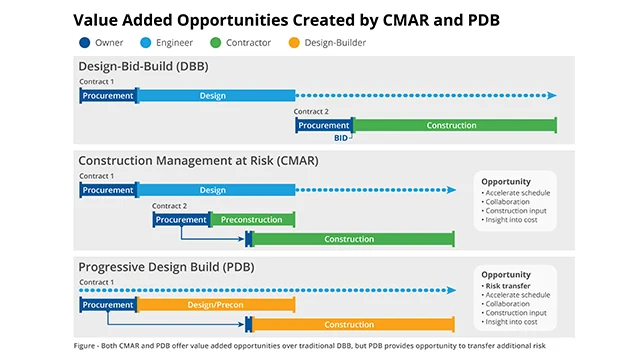
Under progressive design build, the owner executes one contract for design and construction, simplifying accountability and enabling earlier, construction-informed decisions that improve constructability and compress timelines. Following a qualifications-based selection (QBS) method, the two鈥憄hase approach avoids premature design competitions, reduces pursuit costs and gives owners meaningful influence on design and buyout decisions during Phase 1. When paired with early work packages, PDB promotes collaboration to shorten overall delivery, by overlapping design and construction where appropriate.

With increased collaboration, CMAR enables risk mitigation but still offers a risk profile comparable to a DBB project. On CMAR projects, owners contract for engineering and construction under two separate agreements. Under a PDB contract, however, the owner initiates a single contract with a design-builder to advance design and complete preconstruction activities. Unlike CMAR, PBD creates a single point of responsibility and transfers risk as further defined below.

CMAR Risk Graphic

2. Cost and risk confidence through open鈥慴ook pricing and negotiated GMP/target price

PDB鈥檚 open鈥慴ook estimating and structured risk workshops allow the design build team to identify, quantify and 鈥 where prudent 鈥 retire risks before finalizing price. This approach can save time and improve design performance, cost reliability and funding alignment. Open鈥慴ook negotiations, independent cost estimating and progressive contingencies provide transparency and reduce the size of contingencies carried into the final agreement. Owners can also use the off鈥憆amp if price negotiations fail or exceed available funding.

There is an important nuance for owners to consider. PDB fosters collaboration and balanced risk allocation; it does not simply 鈥渢ransfer鈥 all risks to the design builder. Owners may still retain or share specific risks. Permits, utilities/rights-of-way (ROW) and governmental approvals are frequent examples in fixed鈥憄rice design build case law and industry guidance. It makes PDB鈥檚 early, collaborative scoping and price validation especially valuable on complex developments.

3. Adaptability and innovation for evolving regulatory and site realities

Because PDB final pricing is set after key scope, site and regulatory uncertainties are clarified, owners can iteratively design to budget and incorporate operational insights and compliance strategies (e.g., PFAS treatment trains, residuals handling, permitting paths) before locking in a price. PDB鈥檚 agile scoping, procurement of long鈥憀ead equipment, and phased delivery is truly valuable.

Progressive design-build quick guide

  • Phase 1 (Preconstruction):

    Qualifications based selection; collaborative design development; progressive cost modeling; structured risk/contingency workshops; open-book transparency; option for early work packages; negotiated GMP or target price when design is adequately defined; off ramp if no agreement.

  • Phase 2 (Final design & construction):

    Execute the agreed scope, schedule, and commercial terms; continue risk retirement and transparent reporting; commission and closeout.

  • CMAR vs. design-build:

    Formats are similar (QBS plus a negotiated price), but progressive design build assigns design responsibility to the design鈥慴uilder. On the other hand, construction-manager-at-risk and construction manager/general contractor (CMAR/CMGC) methods leave the design contract with the owner. That approach is one reason why an owner might favor development under PDB when they want contractor input through preliminary engineering and permitting under a single contract.

  • PDB and construction management:

    Teams can have competing objectives on complex design build developments. When conflicts arise, collaboration is key to mitigating cost and schedule impacts. A Construction Manager who understands constructability and field realities can work with the design build team to effectively mediate change orders and resolve technical conflicts. Risk-savvy anticipation, efficient problem-solving and contractor outreach particularly during the bidding phase help to promote project cost, schedule, quality, compliance and safety goals.

Progressive design鈥慴uild offers owners three distinct benefits that map directly to water infrastructure project delivery pressures:

  1. Single鈥憄oint accountability

    with a streamlined, QBS鈥慴ased process and potential schedule gains from early work packages.

  2. Higher cost and risk confidence

    via open鈥慴ook transparency, progressive risk retirement and a negotiated GMP/target price, with an owner off鈥憆amp if needed.

  3. Greater adaptability and innovation

    to meet evolving regulatory, site and O&M realities without sacrificing project lifecycle value.

For owners weighing collaborative delivery options, PDB is a pragmatic choice for developments where risk clarity, transparent pricing and team agility are as important as speed.

Contact Us

Looking for a partner in innovation?

Let's Talk
2 construction workers at solar site