日韩福利 在线

Sustainable water solutions rise with data center expansion

Water report cover

Share this page:

In the age of artificial intelligence (AI), cloud computing and other breakthrough technologies, data centers are the engine driving this advanced computing. Hyperscale data centers use AI servers that consume a lot of energy and generate significant heat.聽

Cooling that computing heat requires a supporting critical resource: water.聽

As concerns about climate impacts magnify worries about the adequacy of water resources, most leading data center companies have made sustainability commitments for both power and water. Many have 鈥渮ero-carbon鈥 and 鈥渮ero-water鈥 pledges they are aggressively working towards with ecosystem partners. The data center surge is opening up dialogue about the industry鈥檚 environmental footprint, leading to many significant cooling innovations in technology and water efficiency in the United States, the global leader in data center sites.聽

Breakthrough alternatives are being explored by both the data centers and the water providers to answer pressing questions: Where鈥檚 the water that鈥檚 needed going to come from? What non-potable options 鈥 reclaimed or recycled water, among others 鈥 offer the best solutions?聽

To what extent are the data centers, states and communities engaged and proactively thinking about their water situation to meet this growing water demand? The short answer is that it鈥檚 developing, the 日韩福利 在线 & Veatch 2025 Water Report finds. Based on a survey of 680 U.S. water sector stakeholders, our annual water report for the first time in its 14-year run introduced the data center topic by taking the water industry鈥檚 pulse.聽

It鈥檚 technology, innovation and partnering with data center communities that鈥檚 the story.聽

Meeting AI鈥檚 demands: Data centers rethink power and water strategies

While the tech industry long has relied on data centers to run everything from social media to financial transactions and email, new artificial intelligence (AI) technology requires ever-increasing computational power. As the need for this technology grows, so does the need for data centers and the investment appetite. Goldman Sachs, in a research newsletter last year, reported that large tech companies have ramped up capital expenditure to support generative AI development, with estimates that a staggering $1 trillion will be spent over the next few years on data centers, semiconductors, other AI infrastructure and grid upgrades.聽

Certain locations in the United States have become hotbeds for such enterprises, with northern Virginia leading the way with its 鈥淒ata Center Alley鈥 鈥 the world鈥檚 biggest concentration of data centers 鈥 followed by Texas, Ohio, Arizona, Illinois and Georgia. Smaller municipal areas now are attracting data centers that traditionally have clustered in 鈥渓egacy markets鈥 in large metropolitan areas where the energy and water they require are more available and sustainable.聽

This is the first time the water report has posed questions about demand for water from data centers. It鈥檚 clear that the demand is still emerging with only 14% of respondents noting direct demand for water from data centers 鈥 including the AI variety 鈥 in their area, though data centers are starting to be developed in secondary and more rural areas.聽

Depending on the geographic location and the cooling system, a data center may use millions of gallons of water a day. Nearly six in 10 respondents (58%) say data centers haven鈥檛 impacted water demand from them. An additional 28% report being unsure (Figure 18).聽

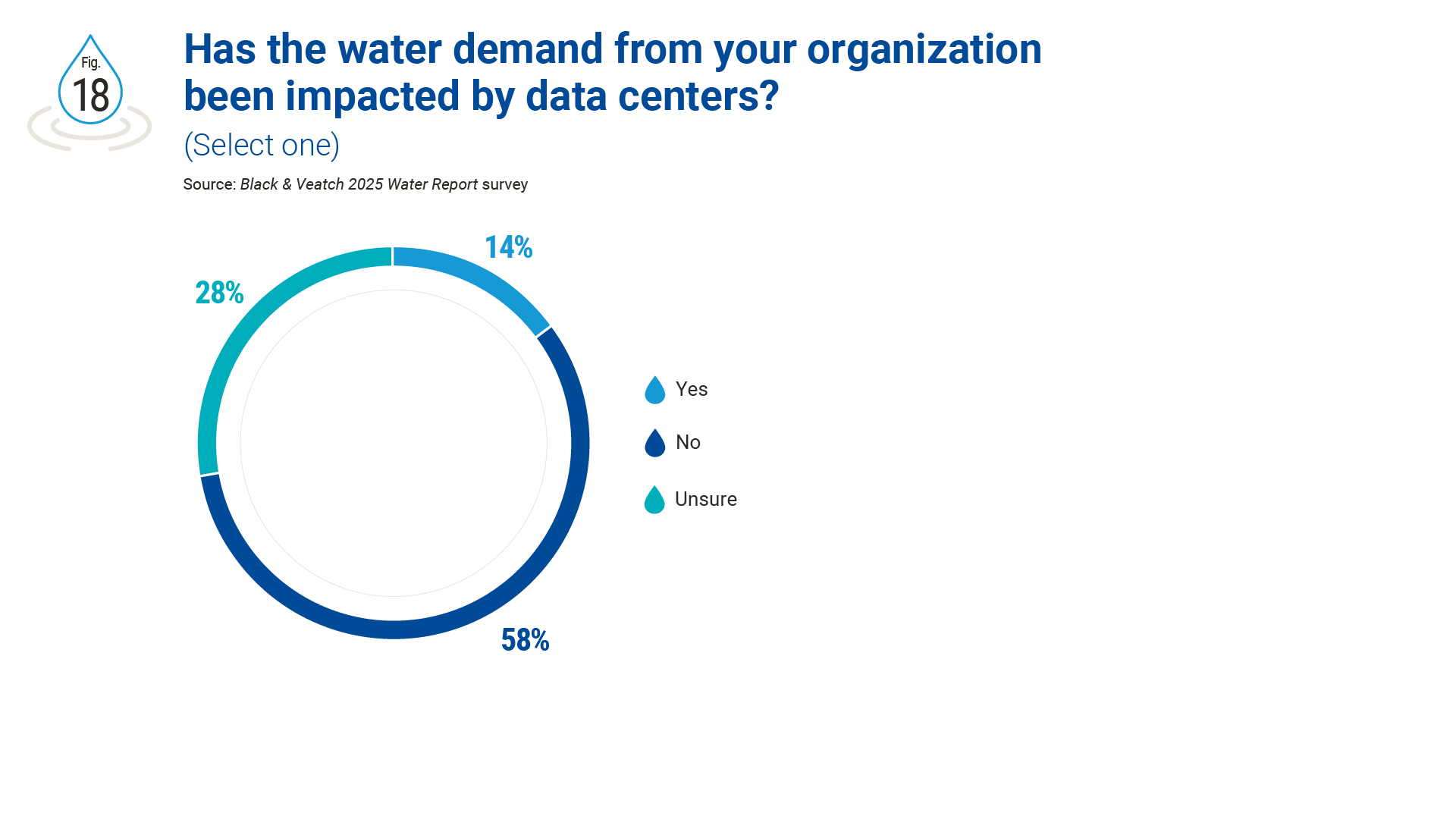
water report figure 18

When asked whether they鈥檝e seen an uptick in demand for recycled or repurposed water because of data centers or technical manufacturing, two-thirds said no. While just 12% replied affirmative, that number likely will increase, notably as data centers continue their growth and water repurposing accelerates as a viable cooling solution. Given the velocity and geographic concentration of data center growth to date, the largest water providers have been meeting the greatest share of the increasing water demands. It鈥檚 anticipated that in future surveys the data center impact will also be observed in the suburbs and rural areas.聽

As global law firm , most technology companies have ambitious water-positive targets for their data centers鈥 operations and increasingly are exploring and applying technologies to reduce and minimize water usage.聽

A case in point: Microsoft. The leader in cloud computing and AI 鈥 with 300 data centers worldwide 鈥 a new approach to cooling data centers in which water won鈥檛 be lost to evaporation, avoiding the need for more than 125 million liters of water annually for each data center. As part of that closed-loop system 鈥 what the company calls 鈥渮ero-water evaporated designs鈥 鈥 water flows past heat-generating processing chips, funneling the heat to chillers before the water repeats that cycle. Microsoft said projects in Phoenix and Mount Pleasant, Wisconsin, will pilot the new system next year 鈥 and begin coming online in late 2027 鈥 鈥渁s we work to make zero-water evaporation the primary cooling method across our owned portfolio.鈥澛

In the meantime, that Google is working with communities around the world to enhance clean water availability as part of its water stewardship program. as part of its program, according to Sustainability magazine. And ESG Lore reports, in 2024.聽聽

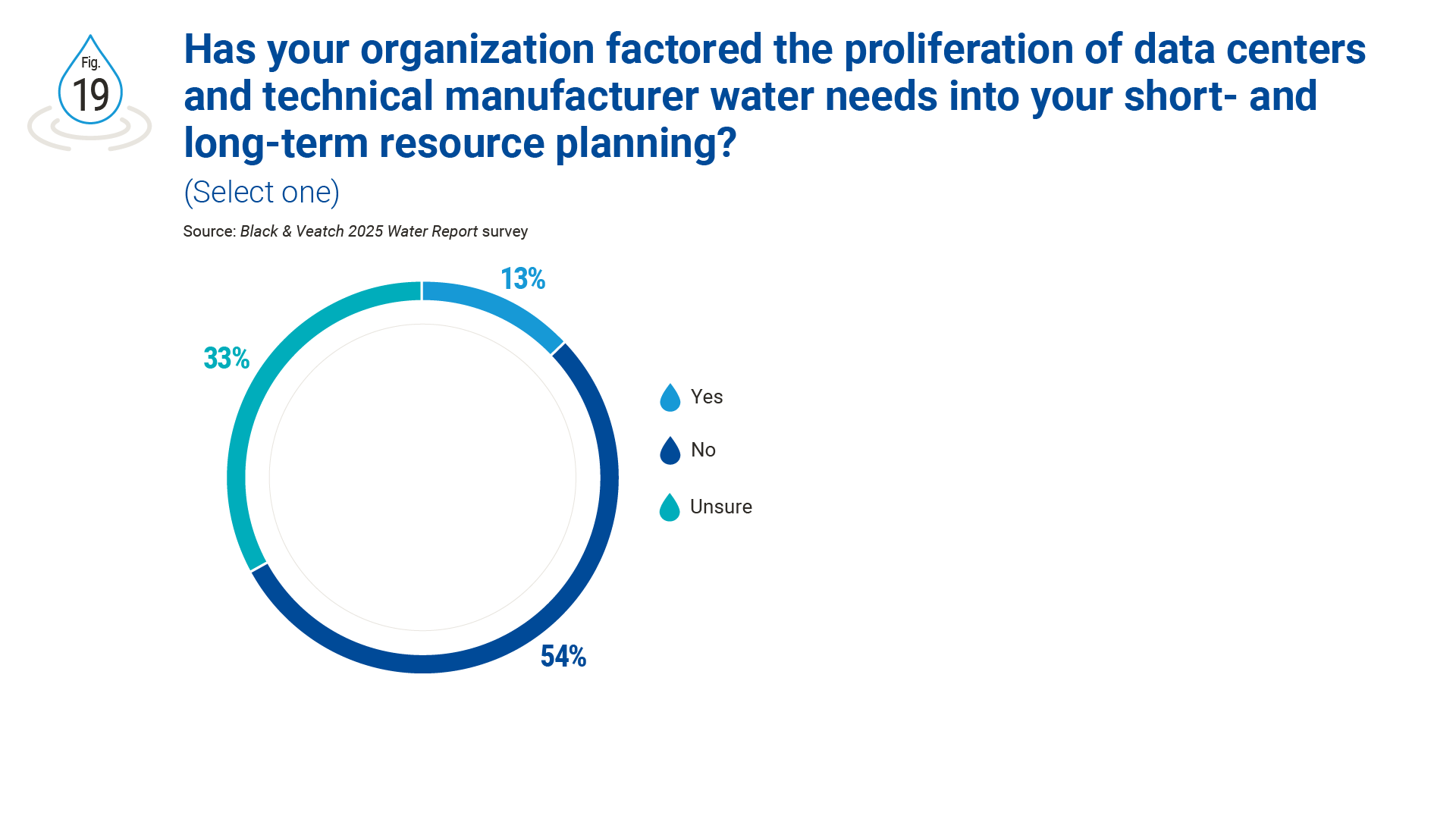
The impact of data centers and technical manufacturers on short and long-term water utility planning is still emerging. More than half of respondents (54%) say that鈥檚 not part of their short- or long-term planning 鈥 and one-third aren鈥檛 even sure (Figure 19). As demand for technology, AI and cloud computing increases along with corresponding demand for water, water utilities can be aware of the trend and ready to engage with ecosystem players to forecast supply.聽

water report figure 19

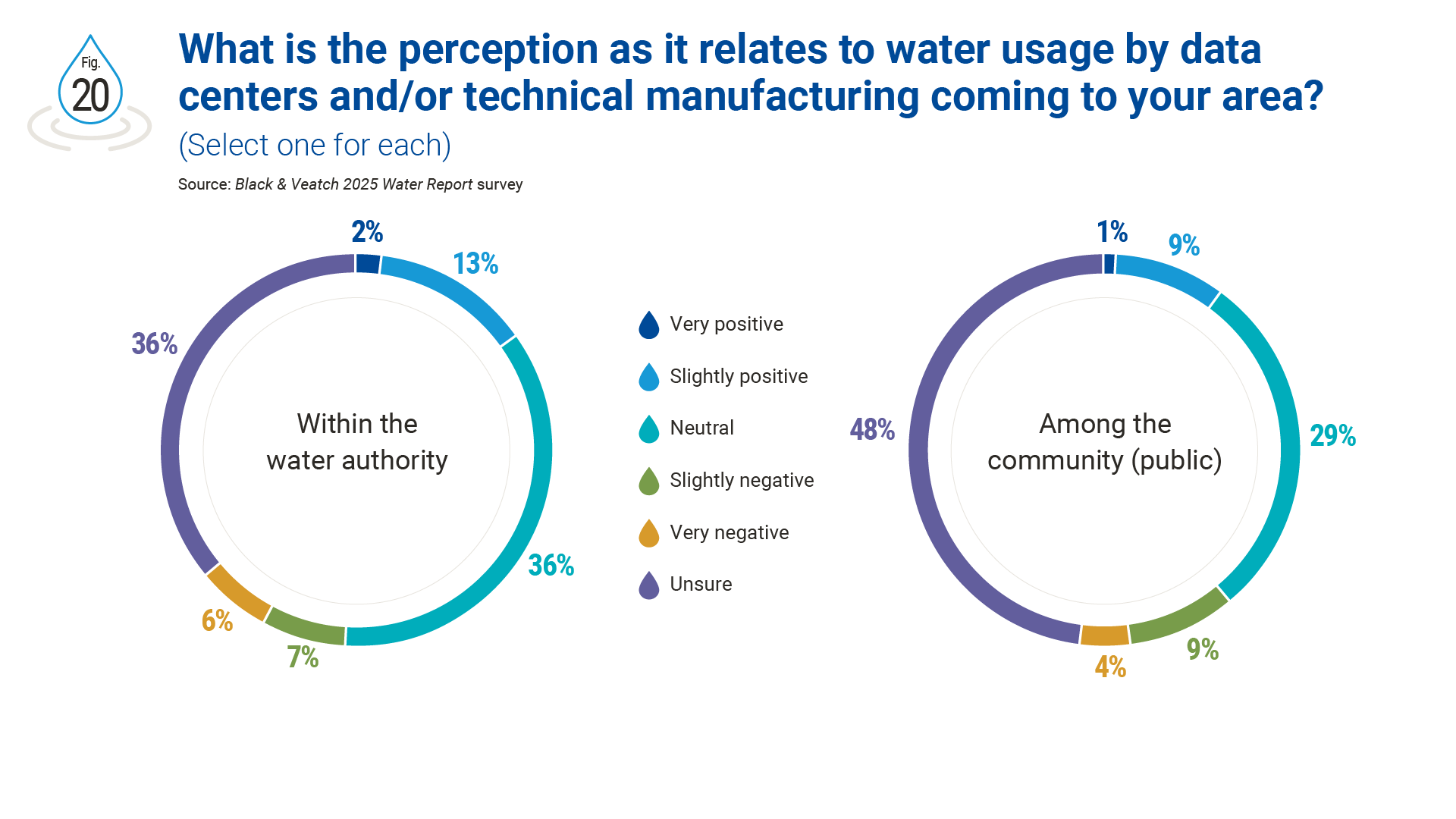
Given their potentially high water need for computing demands, data centers have generated concerns in a few communities. Thirteen percent of respondents rated their perceptions about water usage by data centers and technical manufacturing coming to their area as slightly or very negative, both within the water authority itself and the community at large. Thirty-six percent voiced neutrality within the water authority, seven percent points more than in the community 鈥 numbers that could shift either way as more communities are educated about the pros and cons of data center water needs and their efforts in restoring water (Figure 20).聽

Water report figure 20

Locally, 11% of respondents said in a separate question their organizations welcome new demand from data centers or technical manufacturing, with 2% discouraging them. Half of respondents note their enterprises are neutral, as communities balance economic growth and change with natural resource supply.聽

Power, water and planning: Communities respond to data center demand

As data center locations balance out across the U.S. landscape, many communities are proactively completing water arithmetic, assessing the would-be impact of data centers on water and wastewater systems to sort out how much their infrastructure assets can handle. Other communities are diving all in, courting the development in the understanding they鈥檝e got plenty of power and water for them and that data center tax dollars are a welcomed new revenue resource to their communities.聽

Whatever the case, there鈥檚 an awakening unfolding, as water utilities and communities explore and assess the implications of the new world of data centers.聽

Contact Us

Looking for a partner in innovation?

Let's Talk
2 construction workers at solar site